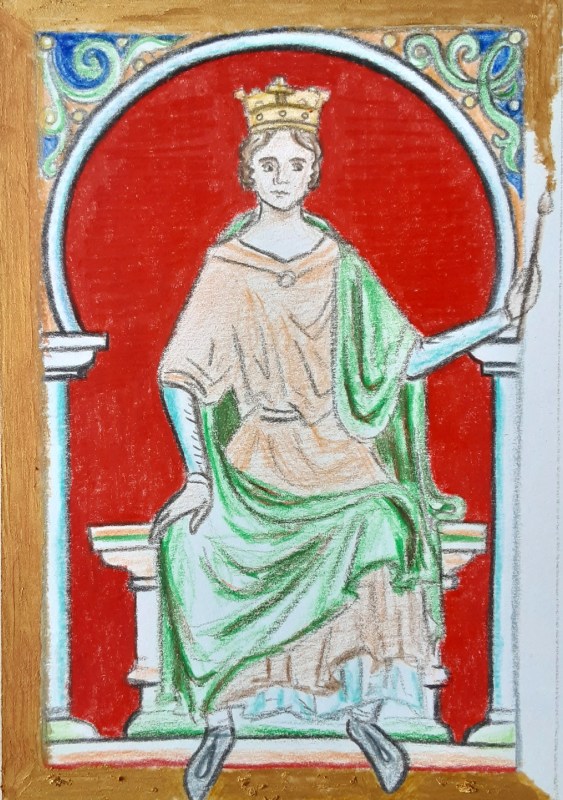
When the beauty of nature inspires you to be creative, how can you respond to it in a way that adds something of value to the world, rather than merely reflecting back what has been shown to you?
There seems to be a widely shared instinct to capture beauty in art, whether it be in sculptures of the ideal human form or in paintings of idyllic fields and blooming cherubs. In poetry, this same impulse often appears as praise of a lover, or in flower imagery. Sometimes poems centering on these subjects are illuminating and imaginative, while others appear trite and simplistic. Showcasing beauty as the topic of a poem does not by itself make the poem worth a reader’s time, even though the reader may wish to encounter the beautiful object in reality.
Though the question here is quite different from the original context of this quote, I keep ruminating about this passage from Shakespeare’s King John:
To gild refined gold, to paint the lily,
To throw a perfume on the violet,
To smooth the ice, or add another hue
Unto the rainbow, or with taper-light
To seek the beauteous eye of heaven to garnish,
Is wasteful and ridiculous excess.
There seems to be a problem that we all encounter in the moment of recognizing beauty in the world–we want to draw attention to it, to show it to others, but in doing so we cannot help but try to change and augment the original, even though in our own experience that very original was more than enough to draw us in. And relatedly, we seem obsessed with showing to others these objects of beauty which they can easily see for themselves, as though we do not trust them to see or appreciate them properly on their own.
Yet there must be a difference between “wasteful and ridiculous excess” in our depictions of nature and a more meaningful depiction. What do we think that we personally can add to the beautiful object? By framing the object through our specific perspective, we hope to connect the audience in the most impactful way with the subject, getting right to the center of its appeal and power. By singling out the most important elements and directing the gaze of others onto those at the expense of other ones, we necessarily distort “reality.” And yet, if done honestly, this new image can get at something more deeply true to human experience and perception than a more candid, unfiltered version could.
Besides deciding how to portray the object of beauty in art in a way that evokes something true about human experience, the artist has the second job of providing the appropriate background for this subject. Though it is a background, its importance is hardly secondary. What makes a work sickly sweet or overly sentimental is sometimes the lack of an appropriate background layer to contrast with the main object. This is not to say that every lovely rose must be overtly paired with a creeping mildew threatening to destroy it–that type of contrast can be just as simplistic. But I think that the beautiful object, even if artistically exaggerated to heighten its impact, has to be grounded by the rest of the work to reality in a way that justifies the focus on the subject. The background should add nuance and context to the subject without attempting either to subvert it completely or elevate it obsequiously.
For example, Wordsworth’s “I Wandered Lonely as a Cloud” can at a glance appear to be a simple poem praising the beauty of nature, in which the poet’s heart is delighted by an unexpected view of a field of daffodils. This huge mass of brilliant flowers is the object of overwhelming beauty to which the poet dedicates three stanzas of imagery. The contrast which gives this image depth is the emotional and psychological state of the poet himself. The daffodils pull him out of his loneliness, and they also stay with him as a recurring element in his solitary moments afterwards. The flowers really enrich his inner landscape and have the power to turn a vacant or brooding moment into a positive feeling of connection to the world.
Though it is only sketched out by a few words and phrases, this “background” provides a meaning and a context for the image of the daffodils. Their importance outlasts the moment of their appearance–the memory of them becomes part of the poet, stored in his “inward eye” as a permanent source of nourishment. Far from being a frivolity, the flowers are a necessary balance to the ever-present struggles of the human spirit. This idea is explored more fully in Wordsworth’s Lines Composed a Few Miles Above Tintern Abbey, where in even stronger language he speaks of the tranquil restoration brought to him by memories of natural beauty, “In which the heavy and the weary weight / Of all this unintelligible world, / Is lightened.”
I hope, then, that we can clear Wordsworth of any charge of gilding the lily–or in this case, the daffodil. And if a poet is to hand us anything shining with gold, may it be only a gilded frame–that is, the beautiful crafting of structure, rhythm and language–though which we can better appreciate the image of the world composed within.
